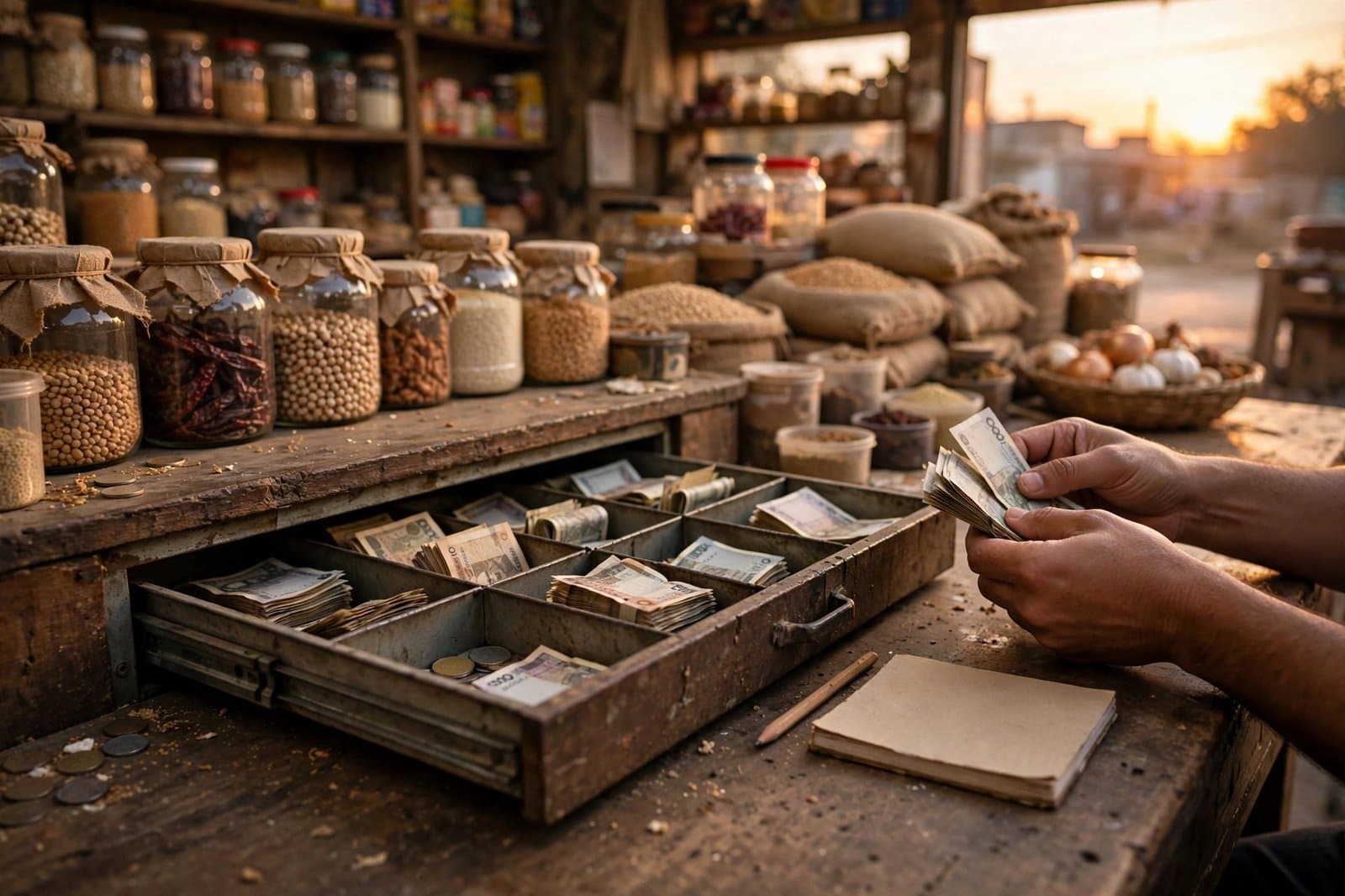
It is the most common mystery in small retail. Sales are good, the books show a profit, the drawer was full at closing — and yet there is never quite enough cash when the supplier's van arrives, or when school fees are due. Where does it go? Nowhere mysterious. It goes to the three places profit hides: udhar given to customers, stock sitting on shelves, and the owner's own pocket.
Profit is an opinion; cash is a fact. Your profit figure assumes every credit sale will be paid, every stocked item will sell at full price, and the money you took home for household expenses was somehow not a business cost. Cash does not assume. It simply counts what is actually in hand. Running your decisions on profit while your cash quietly drains is like driving by looking at the map instead of the road.
The three places your cash hides
- In your customers' pockets: every rupee of udhar is profit on paper and nothing in hand until it is collected. A growing khata with slow collection is the number one reason profitable shops feel broke.
- On your shelves: stock you bought but have not sold yet is cash frozen in cardboard. Over-ordering “because the scheme was good” converts cash into slow-moving cartons.
- In your household: the daily withdrawals — sabzi money, a child's school fee, a relative's loan “just for a week” — are the owner's drawings. They are legitimate, but if they are unrecorded and unlimited, they silently eat the working capital.
The two-pocket rule
The single most powerful cash habit for a small shop is embarrassingly simple: separate business money from personal money. Two cash boxes, two envelopes, two bank accounts — whatever fits your scale. Business income goes in the business pocket; household spending comes out of the personal pocket, funded by a fixed amount you “pay” yourself.
That fixed amount is your salary. Decide it monthly, based on what the shop can genuinely afford, and treat it as seriously as a supplier payment. When household needs exceed it, you will feel the pinch — and that pinch is valuable information. It tells you the shop needs to earn more or the household needs to spend less, instead of the usual silent drain where nobody knows which is true.
“Pay yourself a fixed salary from the shop, even if the shop is yours. Unlimited drawings turn every household expense into a business crisis.”
The 10-minute weekly cash-up
Once a week — pick a quiet time — do a cash-up. Count the actual cash in the drawer and the business pocket. Then compute what should be there: last week's cash, plus cash sales, minus cash purchases, minus expenses, minus your salary. The two numbers should match. When they do not, do not shrug; investigate the same day. Small gaps found weekly are usually innocent mistakes — a forgotten expense, a mis-recorded sale. Small gaps found monthly are mysteries, and mysteries in cash have a way of repeating.
Keep a one-line daily record too: date, cash in, cash out, balance. It takes two minutes at closing and it is the raw material for everything — spotting your best and worst days, planning for slow months, and proving your income if you ever apply for a business loan.
Keep a cash cushion
Aim to keep enough cash in the business to cover one to two weeks of regular expenses — supplier payments, rent, salaries. This cushion is what lets you say yes to a good bulk deal, survive a slow week, and pay the supplier on time even when customers pay you late. Build it gradually: even setting aside a small fixed amount weekly gets you there in a few months. A shop with a cushion negotiates from strength; a shop without one takes whatever terms it can get.